Email Newsletter
The science behind how Sound Baths work.
Sound is to the nervous system what food is to our physical bodies: food provides nourishment at the cellular level of the organism and sound feeds us the electrical impulses that charge our neocortex. Sound can be used as a tool to de-stress, improve mental productivity; accelerate learning, minimise pain, and facilitate healing. It is time to take back the space around our ears, to learn to govern our sonic environments or create new and better ones.
Ancient cultures knew about the power of sound long before the term SCIENCE was coined. The spiritually wise men of India knew that the world is sound. From India’s Vedic scriptures coins the term nada brahman – the primal sound of being or being itself. Even 4 thousand years ago India’s scholars and religious leaders understood that we live in a state of vibration from which sound derives and on which sound has profound influences.
The whole planet vibrates to the rhythms and sounds of music. No matter how primitive or advanced, music plays an inclusive and vital role in every nation. It is inescapable part of life – spiritual ceremonial, social celebrations, child rearing, armies marching off to war, initiations, funeral, harvests and feast days.
Music strikes a chord within us that cannot be expressed easily in words – it can soothe or excite us – we resonate with its rhythms, harmonies and tones and it feels good – we can close our eyes and drift away trusting we are safe in music’s embrace?
Vibration
Virtually everything on earth vibrates – the planet itself vibrates. All matter consists of atomic particles – molecules, atoms, electrons, protons, neutrons and subatomic particles. Each atom consists of a nucleus surrounded by electrons, revolving at the speed of 600 miles per second. It is an accepted construct of physics that Motion creates Frequency and Frequency creates Sound. Whether we can hear it or not (dogs/horses etc can hear more than us), EVERYTHING has a sound, a vibration all of its own. The velocity (frequency) of the movement determines the specific sound. While we hear the sound of a fan moving the air, we cannot hear the sound of an electron – it’s speed is so fast that it creates a tone outside our human range of hearing – but the sound is still there! The fact that sound waves are everywhere is an important point of reference in our ability to build conscious sound awareness and to help us reawaken our awareness of sound and the role it can play in our life, then we add in the phenomenon of resonance.
Resonance
Can be defined as “the frequency at which an object most naturally vibrates” For example a tuning fork that is tuned to 440Hz (cycles per second) will when physically struck, vibrate at 440Hz. This frequency is known as its resonant frequency. Weirdly, if you have 2 identical tuning forks made to vibrate at 440Hz and you strike one of them to make a sound, the 2nd one (which you haven’t struck) will spontaneously vibrate or sing along with the first tuning fork. It acts too as if it were physically struck, but it was struck by the sound waves of the first tuning fork. But if a tuning fork set to 100Hz was struck nearby the 440Hz fork will not respond. So, when 2 or more objects have similar vibratory characteristics that allow them to resonate at the same frequency, they form a resonant system. (2 violins would do the same thing!) Resonance is a natural ability – substances such as metal, wood, air and even living cells vibrate to a frequency imposed from another source. This aspect of resonance is known as sympathetic vibration.
Sympathetic Vibration
Everything has its resonant frequency – a “home frequency” and we humans are no exception. That is why certain colours or sounds or instruments or songs feel good to us. Those colours or sounds within our home frequency range can make us vibrate from across a room. Our familiarity with their frequency can have an effect on our mood. For example, some love the sound of a Sax and others feel it’s like fingernails down a blackboard! The kids love boomdiddy Vibe FM music and it makes me feel really discombobulated! Different people- different frequency perception – the connotation of sound varies. The concept of sympathetic vibration holds true with people as well – when you are around someone with a similar vibrational rate to your own, you feel comfortable and at ease, likewise, there are other people who seem to rub you up the wrong way by just being near you!! So, when it comes to music and sound – finding sources that resonate positively with you is surely a healthy thing to do? If you passively allow yourself to be surrounded by sounds that do not resonate well with you, however, you stand a good chance of creating a central nervous system friction (a loop of interference) and continuous exposure could eventually cause you to fall totally out of harmony with your body’s natural state of ease. Secondhand cigarette smoke has been shown to affect others nearby so what about secondhand sound? It is important to realise that sympathetic vibration is contingent not on volume but on pitch – so even the hum of a computer, tv, lights etc may be having an effect on you. Our body is constantly being “vibrated” on a cellular level by both heard and unheard sound frequencies and nowadays by electromagnetic fields of all kinds. The increase in stress-related “dis-ease” is often caused by an over ramping of the central nervous system. A jagged nervous system (sirens, planes, horns, radar etc) is a stressed one – too much time in the Sympathetic (Fight, flight or freeze) and not enough in the Parasympathetic (Rest, digest, repair, rebalance) The goal is not to become paranoid about every sound around you, wondering what it’s doing to you but remember to be selective as we do not have ear lids to block out what doesn’t feel good for us!
The components of Sound
Sound is a sensation caused by an object or objects that vibrate. When we put out a sound, a vibration at a certain rate (frequency) is created This vibration then becomes a sound wave if it is in a medium that allows it to travel (i.e. in which the molecules are not too dense like rubber or putty or where there are no molecules like a vacuum) This information is then transported by molecules (wave motion) – the molecules are not travelling with this information; they are essentially handing it from one to another – serving as transfer points for info. They do this by taking on the vibration of the initial pulse and handing it over to their neighbour as they spring back into place to receive the next impulse – molecule baton passing.
Sound Therapy
This emerging field of healing is based upon the theory of vibration – how frequency resonates and affects our nervous system. It is neurological in nature as it is working with vibrations to create a change in the brain and nervous system.
The Ear and the Body
Because most cranial nerves lead there, the ear has been called the “Rome of the body” (10 of the 12 cranial nerves are affected by the ear) Most cranial nerves regulate the motor functions of the head and neck including all the sensory organs in the head. Most fascinating fact is the ears relationship to the 10th cranial nerve (THE VAGUS NERVE) or wandering nerve as it meanders through the thoracic and abdominal cavities. It’s enormous task is to functionally regulate the following organs:
- Larynx, tongue, voice box
- Heart
- Lungs
- Stomach
- Liver
- Bladder
- Kidneys
- Small intestines
- Colon ….all the way down to the end!!
It also attaches to the Inner and Outer Eardrum on its way south from the brain.
The Vagus Nerve (see Stephen Porges’s work on The Polyvagal Theory) Polyvagal Theory emphasizes the role the autonomic nervous system – especially the vagus nerve – plays in regulating our health and behaviour. Created and developed by Stephen Porges, PhD, the theory describes the physiological/psychological states which underlie our daily behaviour as well as challenges related to our wellness and mental health. By applying Polyvagal Theory to our personal lives as well as to disciplines such as medicine, education, and management, we can understand how safety, co-regulation, and connection are paramount to a healthy human experience.
So, this means that as well as sending signals to all your organs to self-regulate and eliciting the power of the Parasympathetic Nervous System it is also receiving vibrations from the ear drum which is also resonating / vibrating all the above organs too!
Resonance – the importance of it on the human body
As mentioned before, we can pick up on “good or bad vibes” from people if we are able to tune in on a subtle level. In medicine – the practice of Lithotripsy is standard procedure now for dissolving pancreatic and kidney stones with acoustic waves and research has been done on the effect of sound on cancer cells.
Chronobiology
The biological clock depends on light exposure to set itself to the external solar day/night cycle. Mood disorders including depression, bipolar depression, and seasonal affective disorder (SAD) have been found to be linked to abnormalities in the circadian rhythms. German doctors and physicists believe that with the application of the right music (tone and frequency) at precise times of the day, matching the Circadian Rhythms of the body – they can affect a reduction in stress. Note: we respond faster to sound than to sight or touch
Entrainment
Music alters the performance of the Central Nervous System primarily because of Entrainment (Rhythm) – if we can understand the interlocking concepts of Resonance and Entrainment, we can grasp the way external tone and rhythm can heal us or create havoc. Remember: sound affects glass and concrete as well as brain waves, our motor response and our cells. A structure (or person’s) resonance may be thought of as that frequency of vibration most natural to it and most easily sustained by it. Entrainment is the rhythmic manifestation of resonance – so a stronger beat/pulse does not just activate another pulse/beat but actually causes the latter to move out of its own resonant frequency to match it! Playing music at 140 beats per minute will change your heart rate and therefore your frequency of vibration. The Scientific explanation of Entrainment is that any two vibrating bodies will try and synchronize with each other – is it a form of energy ecology?
Here are 3 basic rules of the physics of Entrainment:
- The Resonance Rule – for one system to entrain another the second system must be capable of achieving the same vibratory rate – meaning a human could not entrain with a rock but could with another person.
- The Power Rule – for one system to entrain with another the first must have sufficient power to overcome the second. So proximity is important – distance diminishes the power.
- The Consistency Rule: for one system to entrain the other the first must be at a constant frequency or amplitude – the rhythms must be constant and regular.
Rhythm
Without Rhythm there would be no life? Mother Nature is built on Rhythms – seasons, tides, sun and moon etc. Anything that vibrates is susceptible to the influence of the external rhythms around it. Some rhythmic elements such as traffic noise do the opposite of entrainment – they jangle our nervous system, because the brain is trying to categorise them – it is looking for periodicity or regularity of the traffic patterns, which as we know, is impossible. Our brain is acting like a hard drive that can’t find a file and this means we find it difficult to concentrate on other things. How important is it therefore to have background noise that is calming and conducive to good health and concentration at work and at home?
Frequency Medicine – the work of Dr Alfred Tomatis
Tomatis basic premise is that the primary function of the ear is not communication but rather to charge the brains neocortex with the electrical impulses of sound. He also discovered we can only give voice to the sounds we can hear. (You sing with your ears) If we retrain the way we hear, the result, in simple terms, is a refurnishing of the brain with missing frequencies and he believed the frequency deficits are often the root cause of many states of dis-ease. He also believed that the ear is not “differentiated skin” to the rest of the body, but the skin of our body is “differentiated ear” and that we hear with our whole body.
The Chakra System of Eastern Medicine believes the human body is made of many layers within these layers are major energy vortex’s (Chakras) that are aligned with various organs and functions of the physical body and the energy and mental/emotional systems and if these frequencies/vibrations are not aligned then the body and/or mind will also present in a form of dis-ease. Modern science is now discovering that the 7 major Chakras are actually an extra 7 senses we have in addition to Hearing, Seeing, Touching, Tasting, Smelling.
Tomatis firmly believed that sound is a vital nutrient for our central nervous system – here is a list of his core principles:
- The primary function of the ear is to convert sound waves to electrochemical impulses to charge the neocortex of the brain.
- Sound is a nutrient – we can either charge or discharge the nervous system by the sound we take in via air or bone conduction.
- There is a distinction between hearing and listening. Hearing is passive, Listening is active
- The quality of a person’s listening ability will affect both spoken and written language development and communication skills, confidence and self-image.
- The active process of listening can be enhanced or refocused by auditory stimulation using musical, vocal sounds rich in high frequencies (Sound Healing)
- The healing mechanisms of the unborn child are functional and alert 5 months prior to birth.
Cultivating a new awareness of sound
We are not born with earlids, so we take in every sound around us, although sometimes we are not aware of it. Our reptilian brain, the locus of an ever-present survival instinct, uses sound to assess safety. Our auditory system is always in a state of alertness. Think about how sound is used in shops and restaurants and how it can affect how you feel about shopping or eating there? A new awareness of sound is vital for us to become an open, self-expressive and healthy human. We are equipped with the ability to recycle energy – be it food, light or sound. These elements contain frequencies that can either energise or deenergise us. If we become overloaded with sound, our systems begin to partially shut down and we sometimes don’t even notice its happening until we find we are not hearing as well, and our attention and focus may seem more scattered. We have turned our volume dial down to shut out the sound overload and then one day we wonder why it seems so quiet around us! Perhaps in the future our culture will understand sound as fuel and the ear as a portal for charging the nervous system. Maybe we will give our ears timely attention – we will tend to our auditory health just as we do our hearts, eyes and teeth. Sound is indeed a nutrient for our nervous system and our goal should be to learn how to use sound with the same awareness we would apply to food and drink.
How can we use sound to support health and wellbeing?
Both the heart and the breath (respiratory system) are influenced by sound (we know this is due to the vagus nerve connection) but the effects sound has on the brain is even more fascinating and has been well studied. The electrochemical activity of the brain produces electromagnetic waves know as brain waves. (measured by an EEG). We have been studying brain waves since the 1920s. The four major brain wave states are:
- Beta (14 to 35Hz) normal waking state of consciousness. Alert with a focus on the everyday activities of the world – also present during the states of anxiety, tension, fear and alarm.
- Alpha (8 to 14Hz) relaxed wakefulness such as daydreaming and meditation. They are blocked by sensory awareness, conceptual thinking and strong emotions – generally appear greater when the eyes are closed.
- Theta (4 to 8Hz) near unconscious states, very deep meditation and as you drift in and out of sleep. A state of reverie or a hypnogogic state that produces dream like imagery – difficult to maintain it without intense meditation training. Can also be accessed in some forms of high intensity breathwork.
- Delta (0.5 to 4Hz) found in the deepest part of the sleep cycle and in unconsciousness – they are the longest and slowest waves.
Brain waves work in partnership with the heart rate and the breath rate, and all 3 body pulses are susceptible to the powerful effects of Rhythmic Entrainment. Even within our bodies the natural heart rate, respiratory rate and brain wave cycles will all entrain with each other…slow down your breath and the heart and brain waves will follow. Slow our brain waves and the heart and respiration will follow. They form an interdependent loop connecting each other. Listening to music through headphones – causes entrainment to take place in the brain first, followed by the heart and lungs. In an aerobics class – the rhythmic movements will affect the heart first and then the lungs and the brain. In a yoga class with breath practice – the respiratory system takes the lead and the heart and brain follow, as is also the case when listening to Gregorian Chants*
*Gregorian Chants affect us in 2 ways Each line is as long as a full breath – we start to slow down our breath to that of the singers The other is the “charging effect” of the tenor voices and the frequency they sing at – apparently it has the perfect ingredients to create the body relaxed-mind alert combination identified as ideal for accelerated learning.
Neuroscience and Music
We now understand that music is a biologically ingrained function of the brain and the brain has neural circuitry that is dedicated to music. Music occupies more areas of the brain than language does and music elicits Serotonin and Dopamine (two of our feel good hormones) We should, therefore, be aware of the power of sound and use it consciously – it has been defined as “the thinking people’s drugs” or self help for the nervous system, that can enhance, arouse or depress. Therefore, perhaps we should consider how much and how often we use it.
Vibroacoustics (Sound Baths)
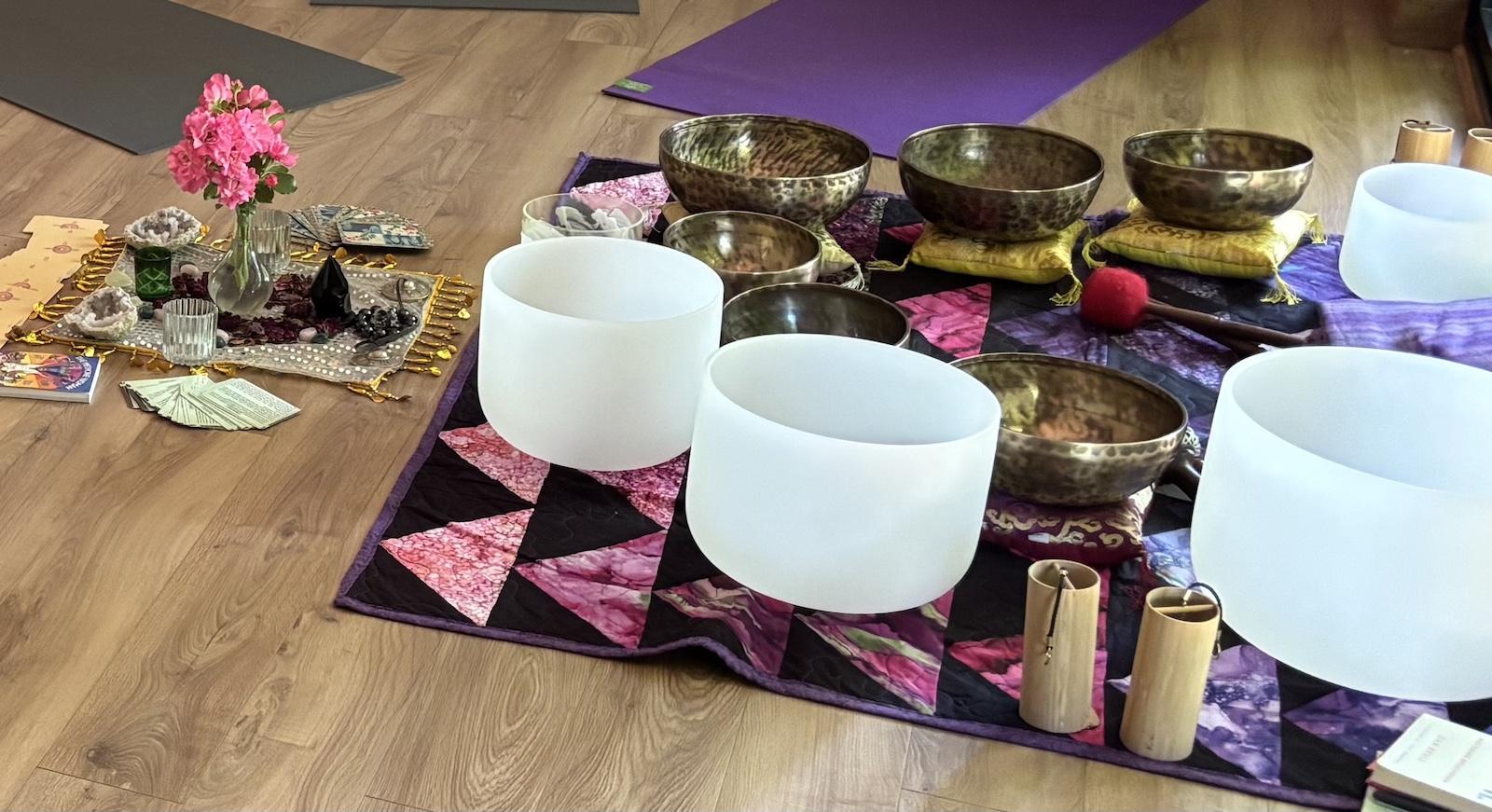
Music and sound vibrations when felt and heard work with the principle of resonance and entrainment and this creates change through one vibration altering another in an attempt to create a state of integration, balance and ease in the energy field of our body. We now know that the body can hold emotional events within its cellular memory. Using different frequencies of sound we can attempt to disengage/release these resonant patterns that seem to run in loops and fixate themselves in the body. This may go part way to explain why some people experience emotions coming to the surface in a sound healing situation in addition to physical sensations in the body. The vagus nerve is the conduit of sound and the vibration can move up or down it. Other research is showing us that sound can be reverberated in our bones and that our skin absorbs sound too (remember the point about the skin being one big ear). Sound researcher and chiropractor Jeffrey Thompson states that a huge portion of the brain stem and nervous system is devoted to sensing and processing vibration. When lying listening to a sound bath, if the surface is in contact with the bowls then the vibrations travel up the spine and get processed in the part of our brain where our most deep seated emotional programs reside. The Davis model of Sound Intervention postulates that every cell in the body emits and takes in sound frequency (electrical energy) so we are one “symphony of sound”. If there is an out of tune frequency the instruments (cells) are not playing the right sound and the symphony sounds discordant. The out of tune frequencies are then identified and the brain introduces the correct frequency to the cell to “tune it up”. The ear is a global sensory processor and the body as a whole is considered to be a vibrational frequency entity.
In conclusion (and this book goes into much greater detail) If we think of the human body as an “earth unit” designed to house the heart, mind and spirit, then ears are standard equipment on all models. If sound is indeed fuel, and the ear the portal, why is it that our owner’s manual is basically blank concerning this important energy component?
If you are interested in experiencing the power of sound on your own physical, energetic and emotional body then please do join me for one of my next Sound Baths? See below for details
Stretch and Sound Bath 24th Sept
7.00 – 8.30pm
Monthly Thursdays
Wind down towards the weekend with a total relaxation and recalibration experience. Join me for 75 mins of “me time”. Gentle Yin Yoga & Breathwork followed by 45 mins of healing and restorative sound from Tibetan, Quartz and Crystal bowls. Finishing with a soothing herbal tea and a snack and go straight home to snuggle and sleep deeply feeling rebalanced and restored. Suitable for all levels £15 per session or discounted 10 class pass available
Book here
If you would like to join The Creative Beings Book Club and review a book, please contact me